

Among these strategies, the Long Straddle stands out for its simplicity and ability to harness market volatility. Understanding the Long Straddle option strategy can provide valuable insights into how to profit from uncertain market conditions while managing associated risks.
Summary
The Long Straddle strategy is an advanced options trading strategy designed to take advantage of market volatility. It involves simultaneously purchasing a call option and a put option on the same underlying asset, with the same strike price and expiration date, which limits the maximum loss to the total premiums paid for both options.
What is a Long Straddle Option Strategy?
A Long Straddle is an options trading strategy that involves buying both a call option and a put option on the same underlying asset, with the same strike price and expiration date. This structure allows investors to potentially profit from significant moves in either direction, making it a popular choice when market volatility is expected but the direction of the move is uncertain.
How does a Long Straddle option strategy work?
The Long Straddle is a simple two-legged option strategy that can be done in all types of brokerage accounts if the investor is approved for a basic option level. The steps required are as follows:
- Selecting a stock with a potential upcoming event that will increase volatility
- Purchase a call and put option on the same underlying security at or near the current price.
- The strike price and expiration date need to be the same for both options.
The investor profits if the price of the underlying asset moves above or below the strike price by more than the total premium paid for both options.
Long Straddle strategy
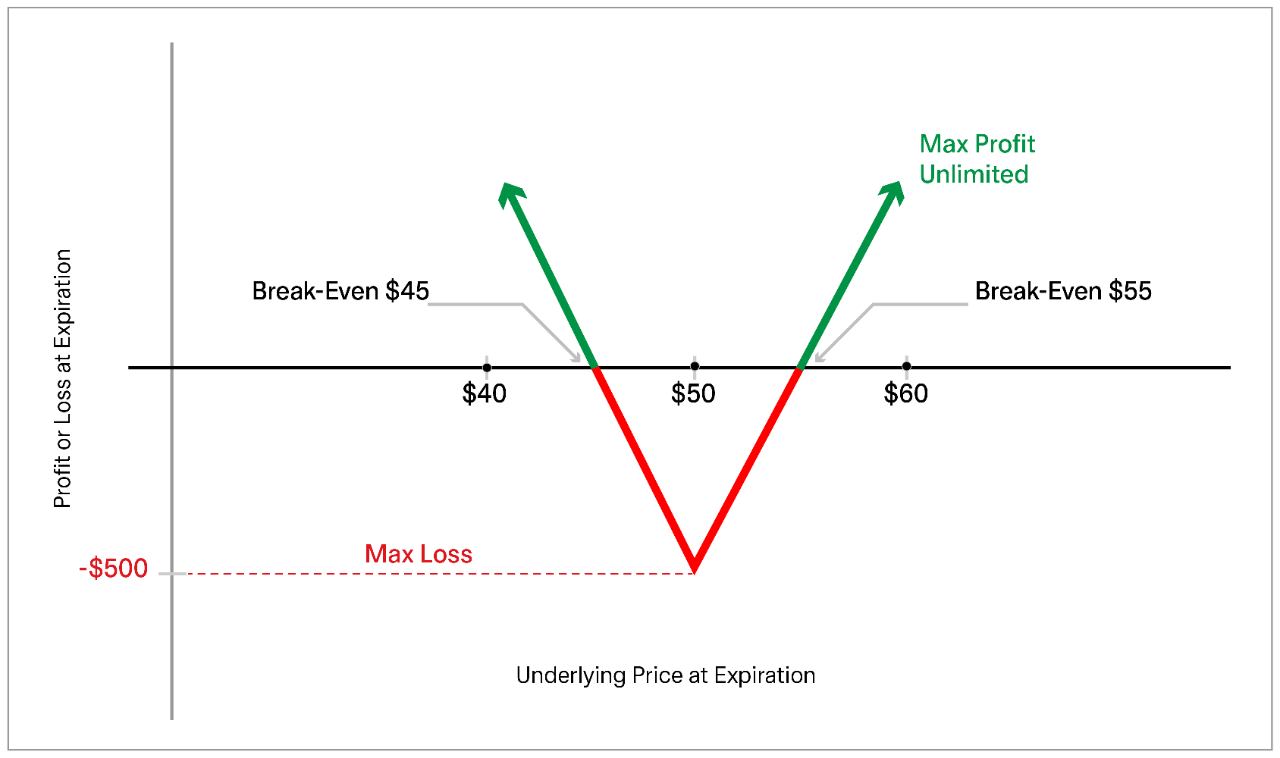
Source: NBDB
Why Investors use the Long Straddle Strategy?
Investors deploy the Long Straddle strategy primarily in situations where they anticipate heightened volatility on a stock or sector ETF because of some upcoming catalyst but are uncertain about the direction of the price movement. Some common scenarios include:
- Earnings Announcements: Companies’ quarterly results often cause sharp price fluctuations, making straddles a popular choice for traders expecting a big move but unsure whether it will be positive or negative.
- Major Economic Events: Events like central bank policy decisions or geopolitical developments can lead to increased market uncertainty, providing fertile ground for straddle strategies.
- Company specific Events: The pending approval/denial of an acquisition, drug, permit or other event that can have a meaningful impact on the company’s future and its share price.
In essence, Long Straddles allow investors to “bet” on volatility itself, rather than on upward or downward price movements.
What are the benefits of a Long Straddle Strategy
The Long Straddle option strategy offers several notable advantages for investors:
- Profit Potential in both directions: The Long Straddle is unique in that it profits from large moves either up or down, making it ideal for unpredictable markets.
- Flexibility: Investors can adjust or exit positions based on new information or even convert a straddle into other strategies as market conditions change.
- Market Neutrality: By not relying on a specific price direction, straddles offer a way to engage with the market without taking a directional stance, reducing exposure to bias or prediction errors.
- Limited risk exposure: The maximum loss is limited to the total premiums paid for both options.
For these reasons, the Long Straddle is often included in the toolkit of sophisticated investors and traders who seek to capitalize on volatility rather than trend.
What are the risks of a Long Straddle Strategy?
Despite its potential, the Long Straddle strategy carries several important risks that investors need to consider:
- Potential loss of entire investment: If the underlying asset price is near the strike price at expiration, both options may expire worthless, resulting in a total loss of the premiums paid.
- High Cost of option premium: The combined cost of buying both a call and a put option can be high, making it difficult to break even unless the asset moves significantly.
- Significant price movement needed: Large price swings are needed; small movements may not cover the cost, leading to losses.
- Volatility risk: Falling volatility can reduce option values, even if the asset price changes, exposing the investor to volatility risk.
- Time value (decay): Erodes option value as expiration approaches, especially if the asset’s price remains stable.
Investors should carefully consider these risks and their own tolerance before using a straddle strategy.
How to place an option trade?
Is the Long Straddle option strategy right for me?
The Long Straddle is not an option strategy that will appeal to every type of investor. Those preferring a buy and hold, or index-based strategies might not be willing to incorporate this strategy into their investment plan.
However, this strategy is suitable for individuals who have a higher risk tolerance, have a solid understanding of options trading, and most importantly are seeking to capitalise on short-term market events such as earnings announcements or other catalysts.
Key takeaways:
- The Long Straddle strategy involves purchasing both a call and a put option with the same strike price and expiry, allowing investors to profit from significant price swings in either direction when market volatility is expected but the direction is uncertain.
- This approach is market-neutral and benefits from large moves up or down, but success requires that the price movement exceeds the combined cost of both option premiums.
- Key risks include potentially losing the entire premium paid if the price doesn’t move enough, high upfront costs, and the impact of time decay and decreased volatility, which can erode option value even if the underlying asset moves.
Want to dive in the option’s world?